Contents · About 6 min read
- The MLB Office — Organizational Structure and Media Rights Scale
- Advertising Inventory — Uniform Patches and Expanding Ad Space
- AI and Data Technology — Statcast and Automated Highlights
- Adopting ABS — A More Cautious Approach Than the KBO
- Comparing League Revenue and Sports as a Content Industry
- Closing Thoughts
📱 View as card news


The MLB Office — Organizational Structure and Media Rights Scale
As I prepared for my 2024 business trip to the United States, the place I most wanted to visit was not a stadium but the Major League Baseball (MLB) offices located in Manhattan, New York. After 15 years working in marketing for a domestic professional team, I was eager to see with my own eyes how the headquarters of the world’s largest sports league actually operates.
The MLB offices are located at 1271 Avenue of the Americas in New York. Acting as the commissioner’s office representing and overseeing 30 clubs, the organization is led by Commissioner Robert Manfred, with executive vice presidents in charge of business and media, and others overseeing baseball operations and legal affairs, each managing their respective domains for the league as a whole.
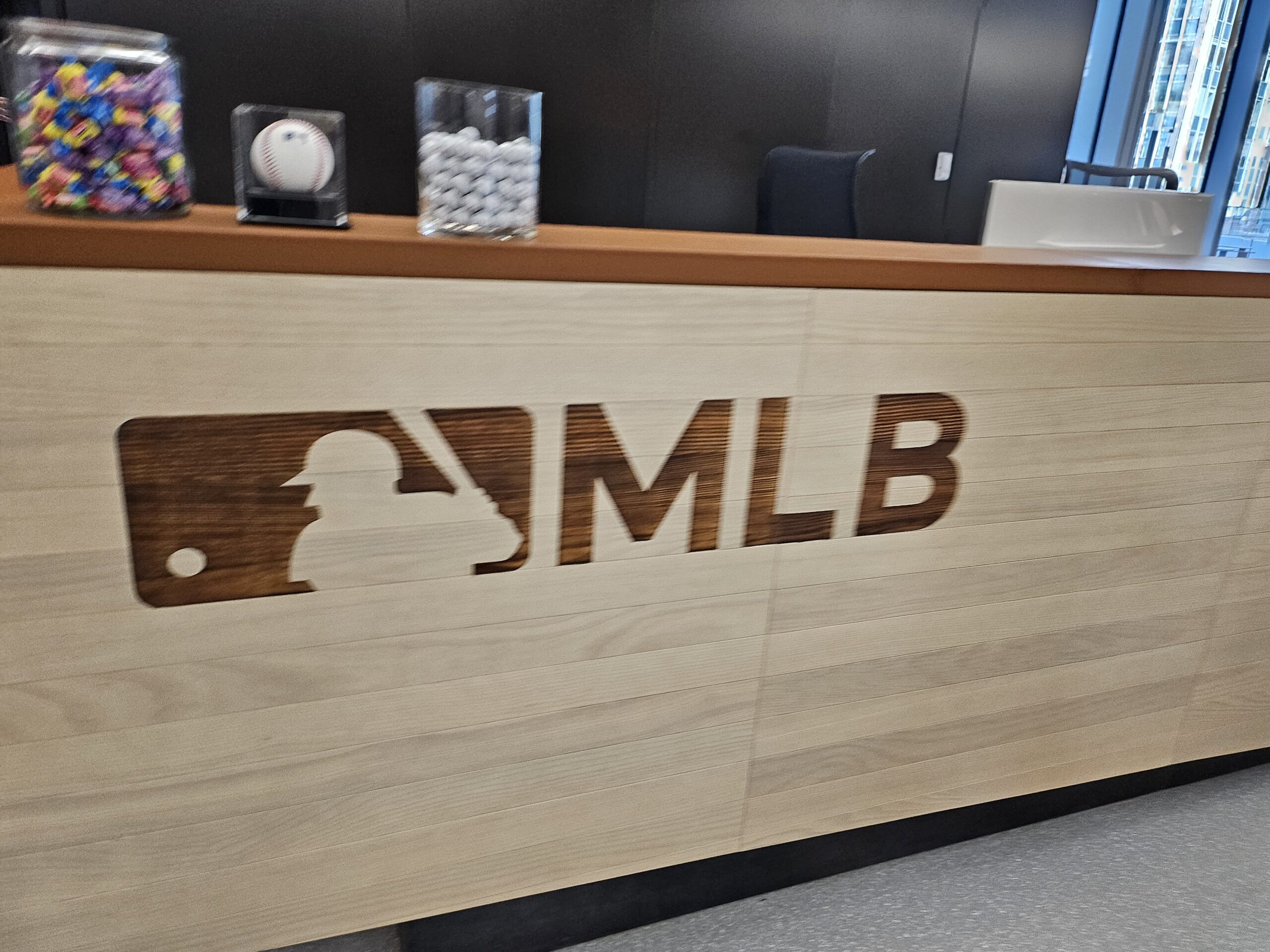
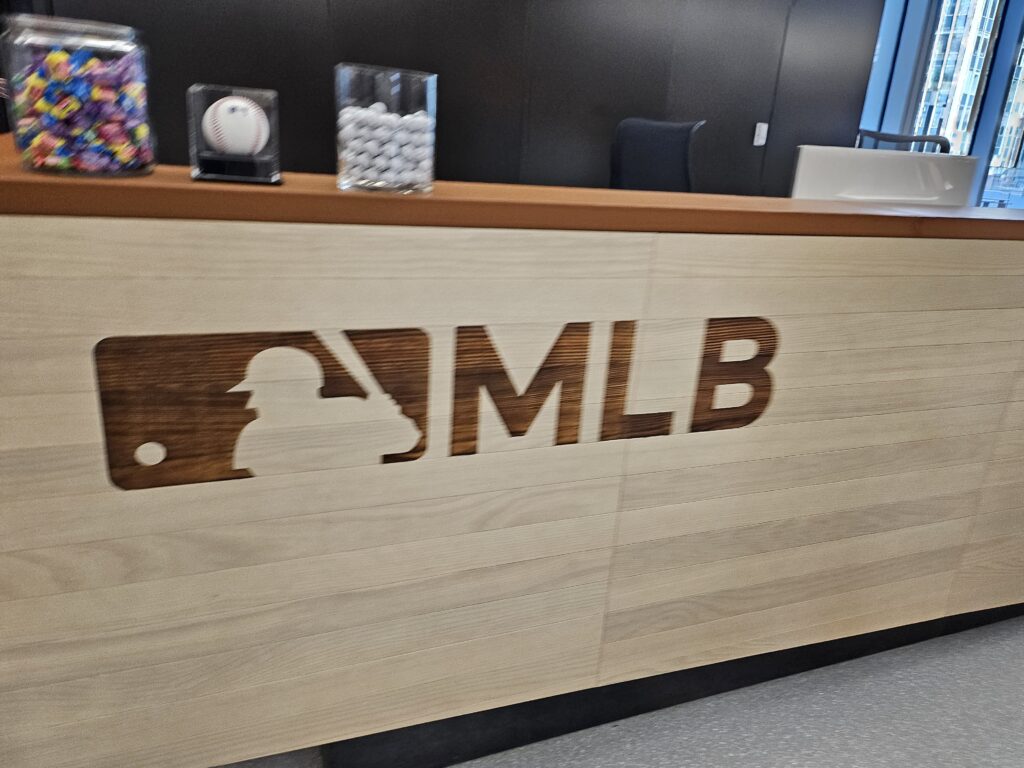
The first thing that caught my eye in the lobby was an intricately carved MLB logo on wood. On the reception desk were a glass jar of baseball-shaped candies and a commemorative baseball placed side by side, giving the impression that even small details in welcoming guests carry the league’s brand.
As a marketer for a domestic pro team, I often visit the KBO offices, and the scale and atmosphere felt quite different. The KBO is organized around a commissioner with marketing operations handled by a separate subsidiary, KBOP. In contrast, MLB vertically integrates all functions—marketing, broadcast and media, technology and data, international business, and sponsorship—within the central office. I was impressed by how the league’s business strategy and execution are directly connected under one roof.
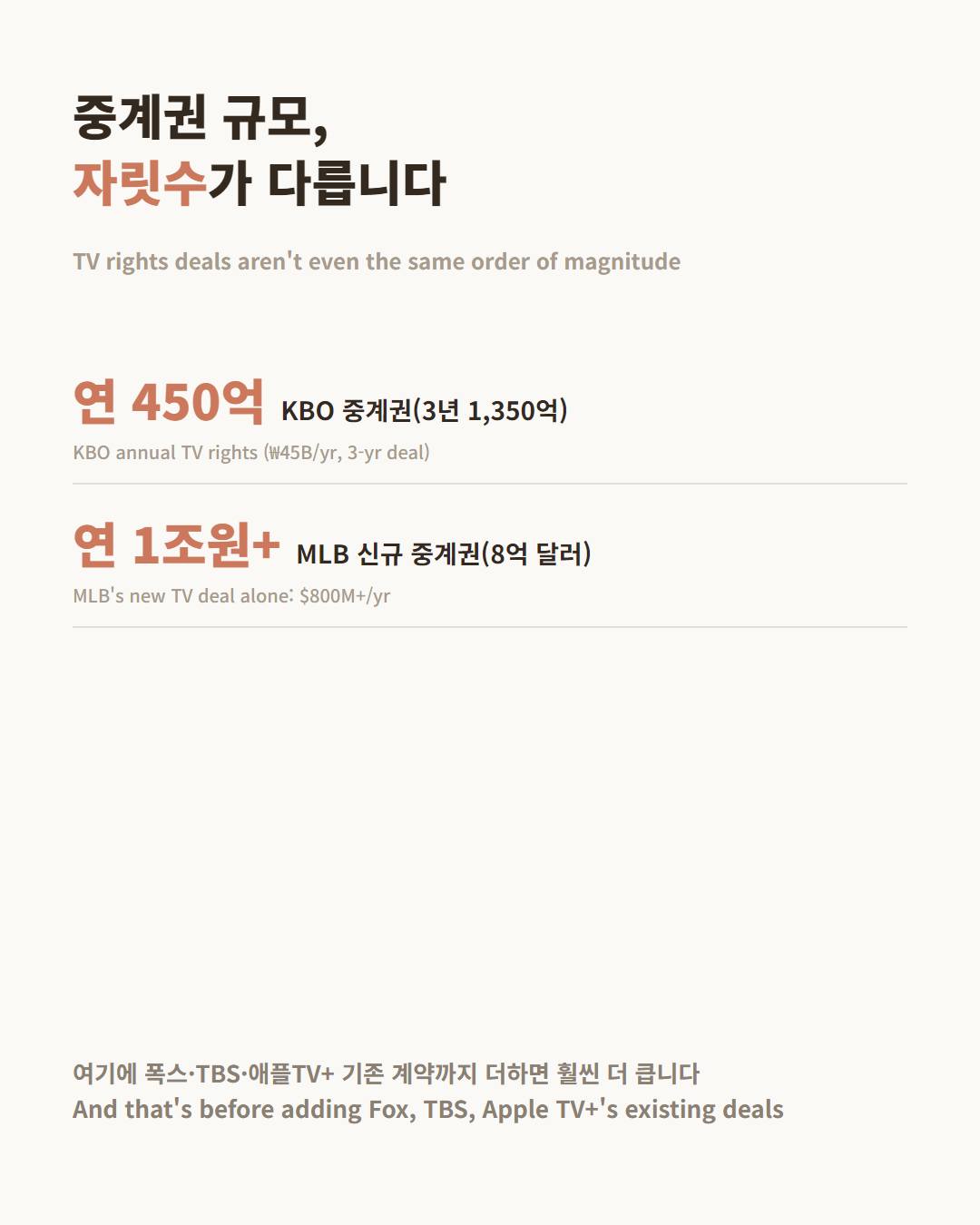
The biggest difference I felt was the size of the media rights. The KBO signed a 3-year, 135 billion KRW deal with CJ ENM for wireless and wired broadcast rights for the 2024–2026 seasons, averaging about 45 billion KRW per year, which was the largest amount in domestic professional sports history.
By contrast, MLB’s recent new deals for the 2026–2028 season with ESPN, NBC, and Netflix alone secure roughly $800 million per year—over one trillion KRW. Adding existing contracts with Fox, TBS, Apple TV+, and others makes the total national media rights revenue much larger. It was striking to realize how large the media value of a single league can become.
An interesting difference was the contract approach. Market size plays a role, of course, but while the KBO awards consolidated wireless and wired rights to a single operator, MLB splits content across multiple platforms such as ESPN, NBC, and Netflix according to content type. Weekday regular-season games go to ESPN, Sunday primetime is with NBC and Peacock, and special events like opening day or the Home Run Derby go to Netflix. The strategy of diversifying exposure by contracting with multiple platforms is something domestic leagues could consider in future broadcast negotiations.
Advertising Inventory — Uniform Patches and Expanding Ad Space
The differences were clear in advertising as well. Since the 2023 season, MLB has allowed sponsor logos on uniform sleeves; patches are limited to within 4 inches by 4 inches, and as of the 2025 season, 25 of the 30 clubs have secured uniform patch sponsors. Clubs autonomously obtain sponsors and retain the revenue.
The KBO already allows ads on both sleeves of uniforms, so in broad strokes it’s similar. However, from the 2026 season the KBO will newly allow physical advertisements visible to spectators behind the mound, and I could feel that the domestic league is steadily expanding its advertising inventory. Yet as a marketer, I constantly consider the balance: new ad space should be expanded only to the extent that it does not harm the spectator experience.
AI and Data Technology — Statcast and Automated Highlights
What inspired me most during the office tour was the use of AI and data technology. MLB has installed 12 Hawk-Eye cameras in each stadium to track pitches, batted balls, and player movement at hundreds of frames per second, building Statcast in every park. This data is used for broadcast features like strike zone displays and batted-ball speed graphics, and extends to generative AI automatically creating highlight captions in English and Spanish.
Adopting ABS — A More Cautious Approach Than the KBO
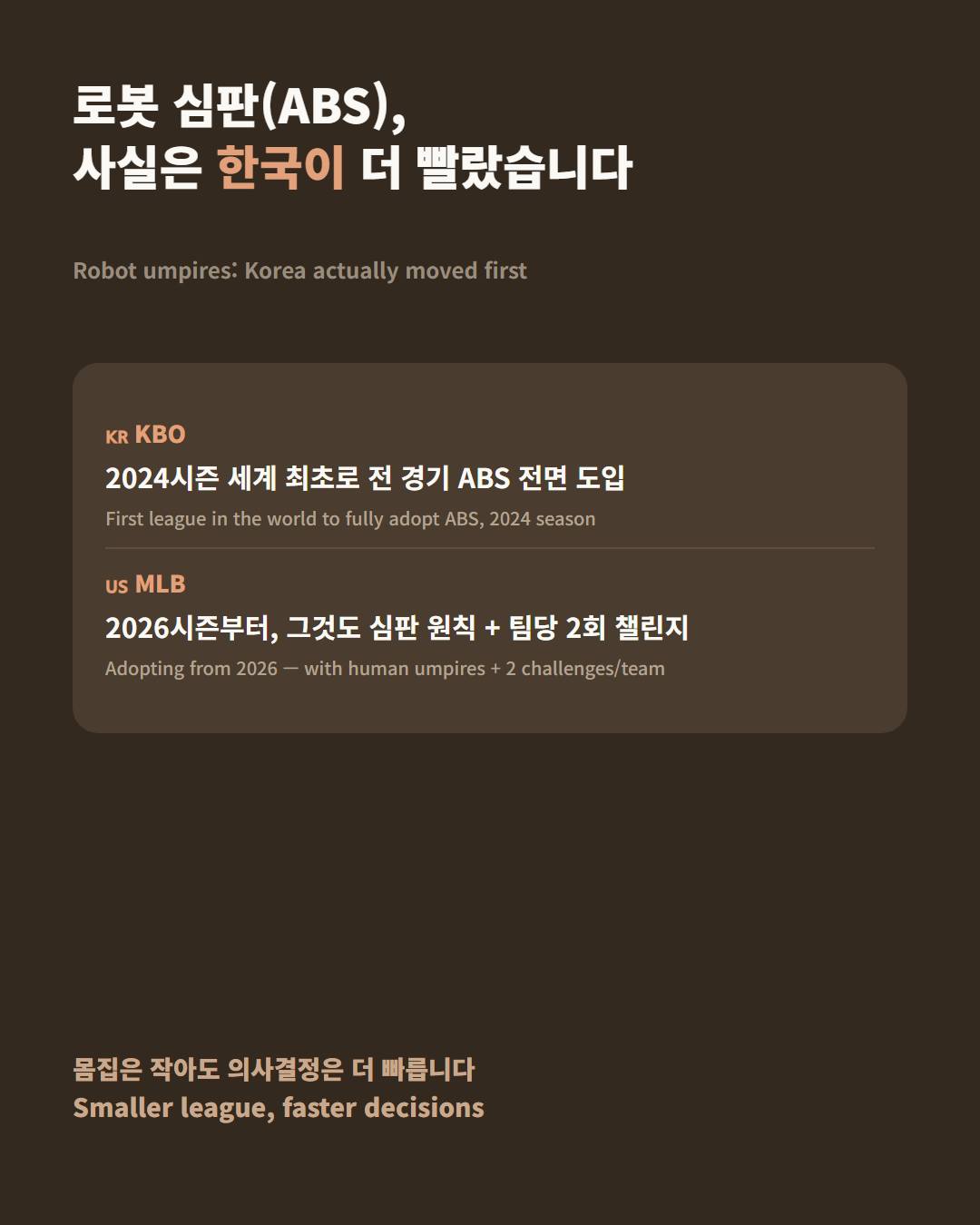
MLB announced it will officially adopt an automated Ball-Strike system (ABS) starting in the 2026 season. However, the approach differs from the KBO’s. The KBO was the first among world professional leagues to adopt ABS across all games in the 2024 season, using machine-made immediate calls, whereas MLB chose a compromise: the umpire’s call remains primary, but teams are allowed up to two challenges per team per game. It was interesting that MLB, often considered the world’s largest and more conservative league, is two years later and adopting the technology more cautiously than Korea. Of course, KBO’s rapid ABS adoption has also generated on-site complaints—ABS zones vary by stadium and the batter-height–based method can diverge from actual batting posture—issues that need refinement.
Comparing League Revenue and Sports as a Content Industry
The gap becomes even clearer when comparing league revenues. MLB recorded an all-time high of $12.1 billion in revenue for the 2024 season—about 17 trillion KRW. The KBO’s attendance surpassed 12 million for the first time in the 2025 season, and some clubs have grown to near or above 10 billion KRW in revenue. While the absolute scales are not comparable, both leagues share the commonality of upward trends in recent years. Leaving the MLB offices, the biggest takeaway for me was that all these differences ultimately come down to how precisely sport is designed as a content industry.
The structure I observed puts baseball at the center as content, with several revenue streams working together around it.
At the same time, as with the KBO being the first to implement ABS across all games, smaller organizations can leverage faster decision-making to lead MLB in adopting technology or new systems. By capitalizing on these strengths while referring to MLB’s multi-platform strategy in areas that require economies of scale—such as media rights and sponsorships—there are lessons to be drawn.
Closing Thoughts
After 15 years working as a marketer for domestic pro clubs and visiting many overseas leagues and stadiums, this visit to the MLB offices is likely to remain particularly memorable. I was reminded that a league’s philosophy and brand can radiate even from a corner of an office lobby—not from a flashy stadium—by that single logo carved into wood.
If you plan to visit New York, I recommend taking a look around the Avenue of the Americas area where the MLB offices are located, in addition to Yankee Stadium or Citi Field.
You can feel firsthand how the heart of the world’s top league beats.
Leave a Reply